Good afternoon.
On to today.

Your Microeconomics I exam is in 2 days.

Today: study Lecture 4 - Supply, demand and equilibrium, about 5 min.

2 of 13 steps

Recently opened

Lecture 5 - Price elasticity of demandyou are on 10 · 12 of 14 explained
Lecture 4 - Supply, demand and equilibriumyou are on 4 · 6 slides
Lecture 3 - Scarcity and opportunity costFinished · 5 slides
Lecture 5 - Price elasticity of demand

Mina is building the summary…

Opening…
Slide
Lecture 5 - Price elasticity of demand

Lecture 5 - Price elasticity of demand

The file changed since I made it.
I couldn't make it.

Mina is expanding the summary…

Mina is adding the new material

What elasticity measures

  • The law of demand says quantity falls when the price goes up; elasticity measures how much it reacts.
  • It's the percentage change in quantity demanded over the percentage change in price, in absolute value.

Mina is expanding this…

How to compute it

  • Changes are computed over the average, so it doesn't matter whether the price goes up or down.
  • From $2.00 to $2.40 and from 500 to 400 coffees: elasticity comes out at 1.22, elastic demand.

Mina is expanding this…

Types of demand and determinants

  • Greater than 1 is elastic, equal to 1 unit elastic and less than 1 inelastic; 0 and infinity are the extremes.
  • More substitutes, more time to adjust and luxury goods make demand more elastic.

Mina is expanding this…

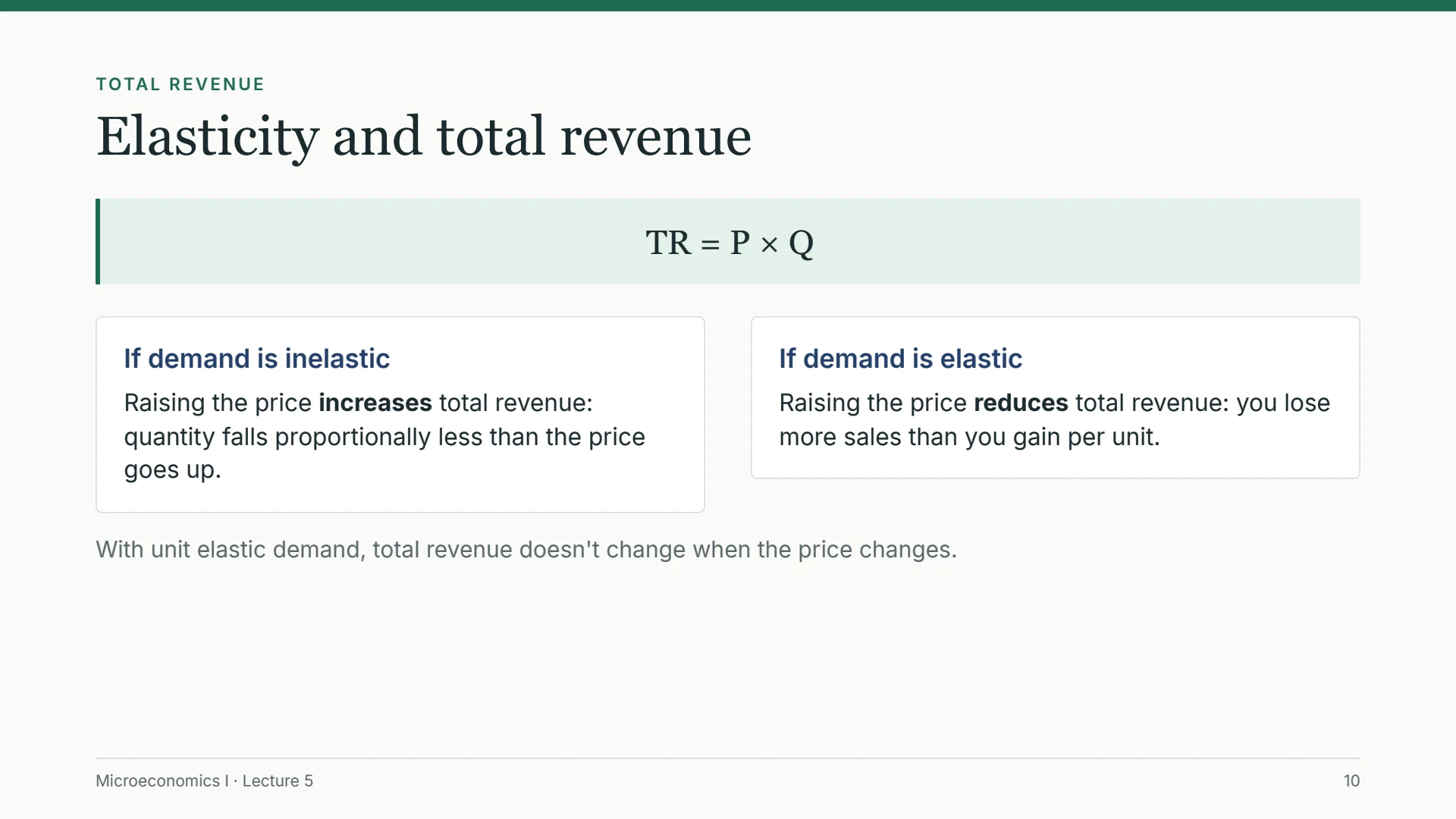
Elasticity and total revenue

  • With inelastic demand, raising the price increases total revenue; with elastic demand, it reduces it.
  • Along a straight line the slope doesn't change, but elasticity goes from elastic at the top to inelastic at the bottom.

Mina is expanding this…

Other elasticities

  • Positive for normal goods, greater than 1 for luxuries and negative for inferior goods.
  • Positive between substitutes, like coffee and tea; negative between complements, like printer and ink.

Mina is expanding this…

Select some text to comment on it.

space listen